(a personal recollection by our Chairman)
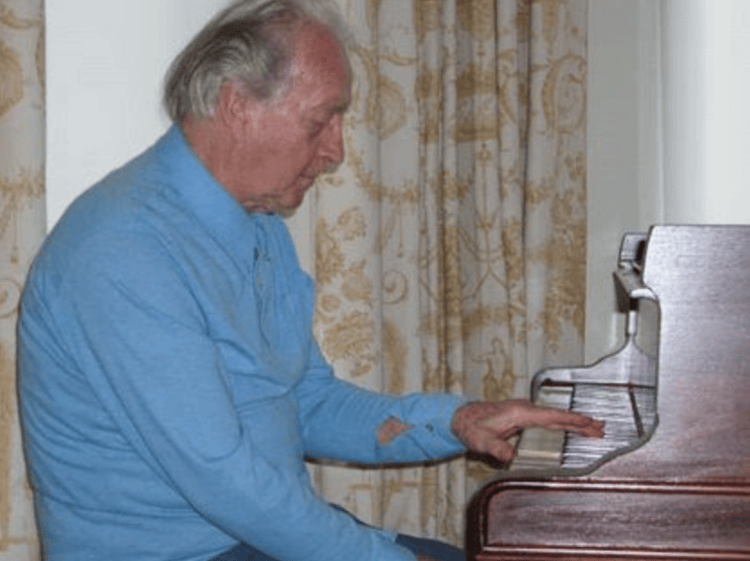
(This article has been compiled from material provided by members of the Club and my own records and memories.)
Ernest Josephus Woolford was born in 1926. His mother was a very fine pianist as was her father. At what Ernest described as a tender age he began learning the piano.
My data for his years up to the war is blank but he did Army service, and then trained as a Chartered Surveyor. In 1952 he had a very busy year – he became qualified and got his Licentiate of the Royal Academy of Music in piano performance, became a father and won first prize at a music festival for his performance of the Liszt concert paraphrase of Verdi’s Rigoletto. Years later he still liked to quote the adjudicator’s comments that it was played with “all the swagger this music cannot do without”.
A year on he had given his first piano recital at a venue in Watford. Then a career in Quantity Surveying and raising a family intervened, but these activities did not stop his playing all together because he managed to wangle a go on Grieg’s piano at his old home in Trondheim. Ernest was in Norway on quantity surveying business, visited the museum and told the staff that actually he should be allowed a go because he’d recently played Grieg’s piano concerto with an orchestra and so was obviously not your ordinary tourist.
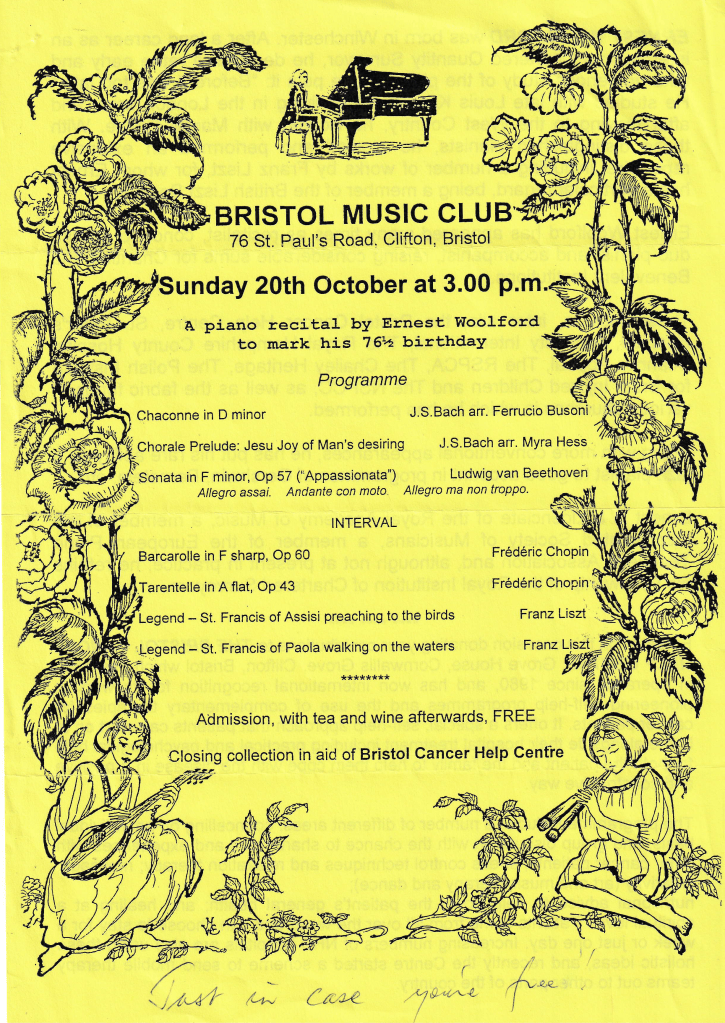
At the very young age of 52 he retired and devoted himself to the piano. He auditioned for lessons with no less a pianist and teacher than Louis Kentner – a prize winner at the 1932 Chopin competition, friend of Kodaly and Bartok, brother in law of Yehudi Menuhin, and particularly famous for his playing of Liszt and Chopin. Ernest told me that his audition piece for Kentner was the Bach-Busoni Chaconne and when he’d finished, Kentner remarked “Well, you can certainly get around the keyboard”. I heard Ernest play that same piece superbly many years later at the Bristol Music Club in his 76 ½ birthday recital. This was very well attended and I remember Ernest being especially pleased to see Allan Schiller there.
Anyway, Kentner took him on which was an achievement in itself as he normally only took professionals.
Both Ernest and I were members of the Liszt Society in the 1970s although I pulled out a few years later. We never met in those days – I was living in Middlesborough and Glasgow, and Ernest was based in the south of England.
From the Liszt Society Magazine of 1977 we read that in December 1975 Ernest played a Liszt Consolation (no. 3) and then having warmed up, launched into Lyapunov’s 12th Transcendental Study – a very transcendental piece indeed! Kentner used to play these Studies and may well have encouraged Ernest to do so. Leslie Howard, the Australian pianist who recorded all of Liszt’s piano music on 100 CDs, was on the scene and played at many of these events. In fact Howard accompanied Ernest in a performance of Liszt’s first piano concerto playing the orchestral part on an Aeolian Orchestrelle -a sort of player organ. I would have loved to have heard that!
Then, from the same magazine, is a report of masterclasses given by Kentner in which Ernest and Leslie Howard, amongst others, participated.
As far as I know, Ernest remained a member of the Liszt Society all his life, and, according to the secretary, in later years used to ring them up on his birthday to let them know he was still alive!
Subsequently, he gave many solo piano recitals and appeared as duo pianist and accompanist with various singers and instrumentalists generally for charities.
He performed virtually a score of major piano concertos by Chopin, Liszt, Brahms (No 2), Rachmaninov (No 2), Schumann, Bach, Grieg, Franck, Britten etc., with orchestras from Bristol and beyond.
Ernest played from memory and was not that impressed when professionals used a score.
With Ann Grayburn and others, he was one of the founder members of the Bristol Piano Club, 20 years old this October.
On a Club website page Ernest commented “all of the meetings are immensely enjoyable both musically and socially whilst the food, wine, general good humour and bonhomie are irresistible”.
Below are some photos that would appear to bear out his comments!
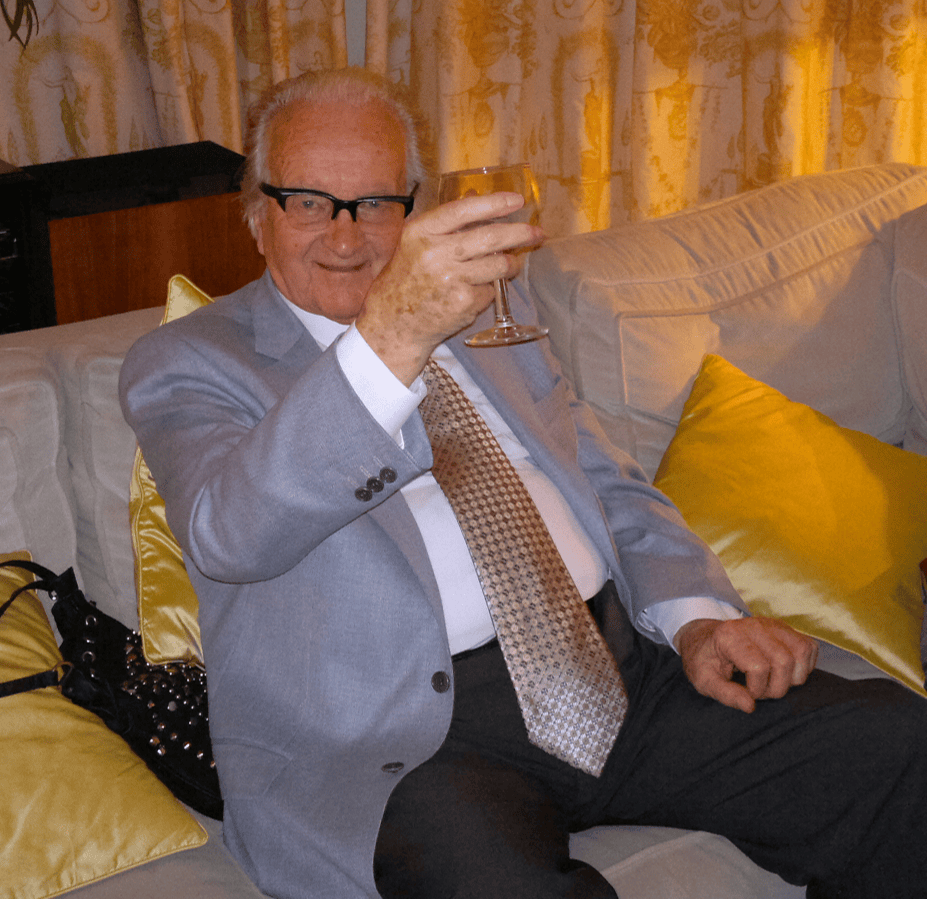
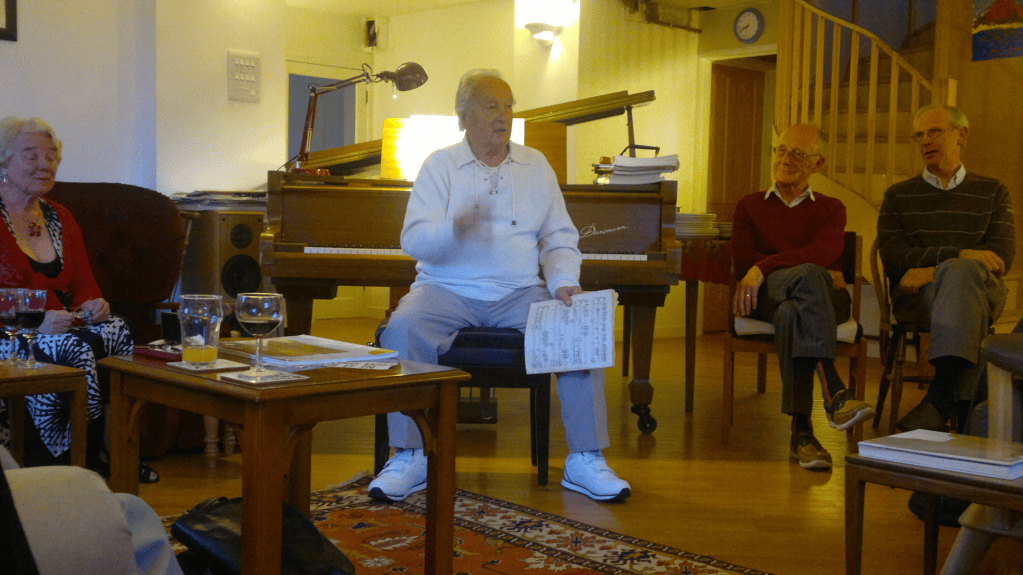
There was a Piano Club outing to Budapest around 2008. Here you can see Ernest sitting on a bench next to a statue of Hungarian composer Imre Kalman.
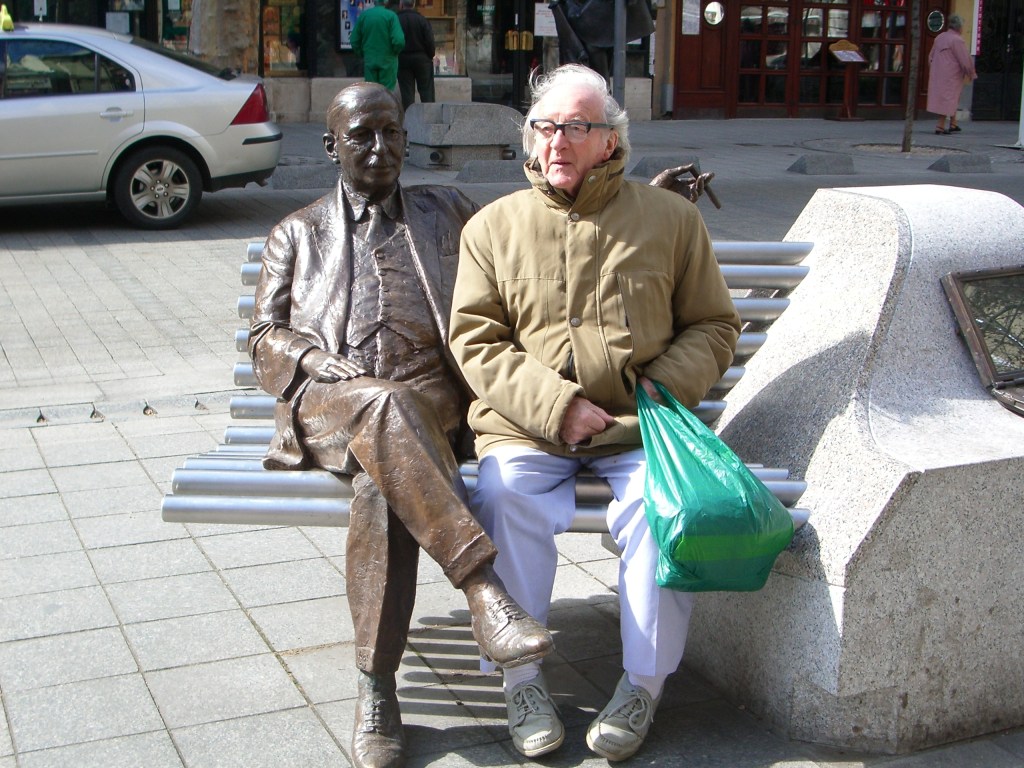
On his return the Weston Mercury reported that Ernest Woolford was wowing fans with his skills on the piano with a recital entitled Musical Memories of Budapest!
He played in a trio called Trio di Brio, consisting of Ernest Woolford on piano, Ray Loadman on cello and Gareth Williams on flute.
From the limited knowledge I had I assumed that Ernest played the more popular sort of 19th century virtuoso repertoire with some Gershwin and Billy Mayerl thrown in. However, to my amazement, on a CD of one of his recitals, lent to me by one of our members, I found a piece by an obscure British composer – the Momenti Musicalles of Patrick Piggott which, on hearing I took to be late Scriabin till I checked the record label. Further investigations revealed that Piggott, academic, author, composer and a former Nadia Boulanger pupil, lived the last years of his life in Clevedon, as Ernest did. I can only assume that they knew each other and that Ernest was given the score of this amazing music which hasn’t been published as far as I know. It would have taken a huge amount of work to learn it.
My own direct experiences of Ernest were few and far between. I used to receive the odd letter from him sent on by the Editor of the piano magazine I occasionally sent letters to. Then we were together on a Chopin weekend run by British pianist and composer Christopher Headington, and I can still remember Ernest playing an immaculate Chopin C sharp minor Nocturne, op. 27. Later I was invited to his 76 1/2 birthday recital at the Bristol Music Club (see earlier programme photo). Then our paths crossed again at a European Piano Teachers Association meeting outside Bath in 2004 and I enjoyed his droll comments on the performances of certain star pupils. Incidentally, a 12-year old Benjamin Grosvenor was there and played a stunning Chopin B minor scherzo with his feet barely touching the pedals – that was impressive!
By the time I joined the Piano Club he wasn’t coming regularly because of his dislike of driving at night but he still made it to some of Jan and John’s Christmas parties where he organised the quizzes and later Cheryl and Bryan used to bring him and Christine along.
A few years ago Ernest suffered a stroke which deprived him of the use of his right hand. He worked hard to recover the use of this hand with partial success. Club members admired his courage and tenacity enormously during this period. He arranged two handed music for his left hand alone e.g. Rubinstein’s melody in F and, incredibly, the 2nd movement from the second piano concerto of Shostakovich! And of course he performed many of the standards of the LH repertoire, for instance the Scriabin D flat Nocturne and Blumenfeld A flat study.
Ernest was married twice and died in October 2025, aged 99. He had two children, Peter and Jane.
At the Club meeting in September we played a couple of Ernest’s recordings beginning with “Au Bord d’un Source” recorded 1989 St Lawrence Church, Winchester (his home town), from Liszt’s Swiss Album of the Years of Pilgrimage. The recording demonstrates his superb finger dexterity very well.
The second recording played was the Adagio from the Busoni transcription of Bach’s Toccata Adagio and Fugue BMV 564. This is a slow, moving chorale, and shows Ernest playing with what is a really touching humility and reverence.
Ernest was a very special and valued member and is much missed by all who knew him.

